Atari 2600 · original game
Klakwall
A bat, a ball and a wall of bricks that will not wait. Every two and a half seconds the wall takes a step down the screen, and when it reaches the bat the game is over.
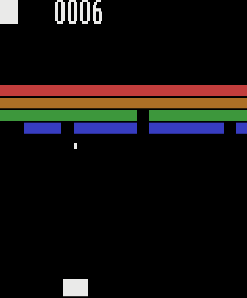
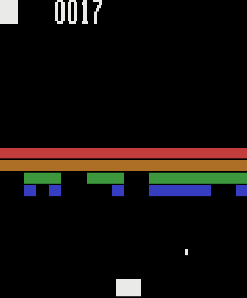
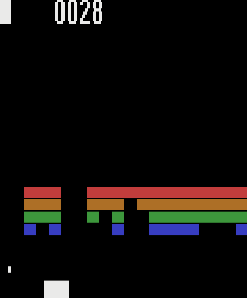
Klakwall is played with the joystick. The bat slides along the bottom of the screen; the ball bounces off it, off the side walls, and off the face of a wall of bricks at the top. Every time the ball strikes the wall it breaks the nearest brick still standing in that column, counting from the front backwards, and the score goes up by one.
What makes it Klakwall rather than something older is that the wall does not wait. Every hundred and fifty frames it takes a step down the screen. The sky above it grows, the space the ball has to work in shrinks, and when the wall reaches the bat the game is over. There is nothing to clear and nothing to win: there is a score, and there is how long you lasted.
When nobody is playing, the title screen plays the game by itself. That attract mode is also why every photograph of it in the book could be taken twice and come out identical.
Where it comes from
Written line by line in Atari 2600 Assembly:
- Chapter 37: Klakwall: paddle, ball, an advancing wall, and the physics of a bounce · ch37/